How to Build Acne Sensitive Skin Skincare Routine (2026)
To successfully build an acne sensitive skin skincare routine that clears breakouts without causing the dreaded “sting” or redness, you need to abandon the “scorched earth” approach. Instead, we will use a barrier-first strategy that combines low-percentage actives with high-performance soothing agents. This protocol is designed to lower skin pH to a healthy 5.5, reduce inflammatory lesions by up to 40% in the first 4 weeks, and strengthen your lipid barrier. Grab your gentle cleanser and let’s start the 5-step recovery process immediately.
Preparation: Choosing Safe Ingredients & Tools
Before applying anything to your face, you must ensure your toolkit is free of irritants. Treating acne on sensitive skin is a balancing act—too strong, and you burn; too weak, and the acne stays.
Pre-flight Checklist
- Time Required: 5 minutes (AM) / 10 minutes (PM).
- Key Actives: Azelaic Acid (10-15%) OR Salicylic Acid (1-2%).
- Support Tools: Microfiber towel (clean) or disposable face tissues.
- The “Banned” List: Physical scrubs (walnut/apricot), Alcohol-based toners, and hot water.
- Mindset: Results typically take 4 to 6 weeks (one full skin cycle).
Why this routine works (The Promise)
Most people fail because they attack the acne but forget the skin. This routine focuses on reducing inflammation and bacteria (C. acnes) while simultaneously feeding the skin Ceramides and Lipids. You should feel a reduction in heat and tightness within 3 days.
The 5-Step Daily Protocol for Clear, Calm Skin
Follow this linear workflow. Do not skip the moisturizing step, even if your skin feels oily.
Step 1 Cleanse Without Stripping (AM & PM)
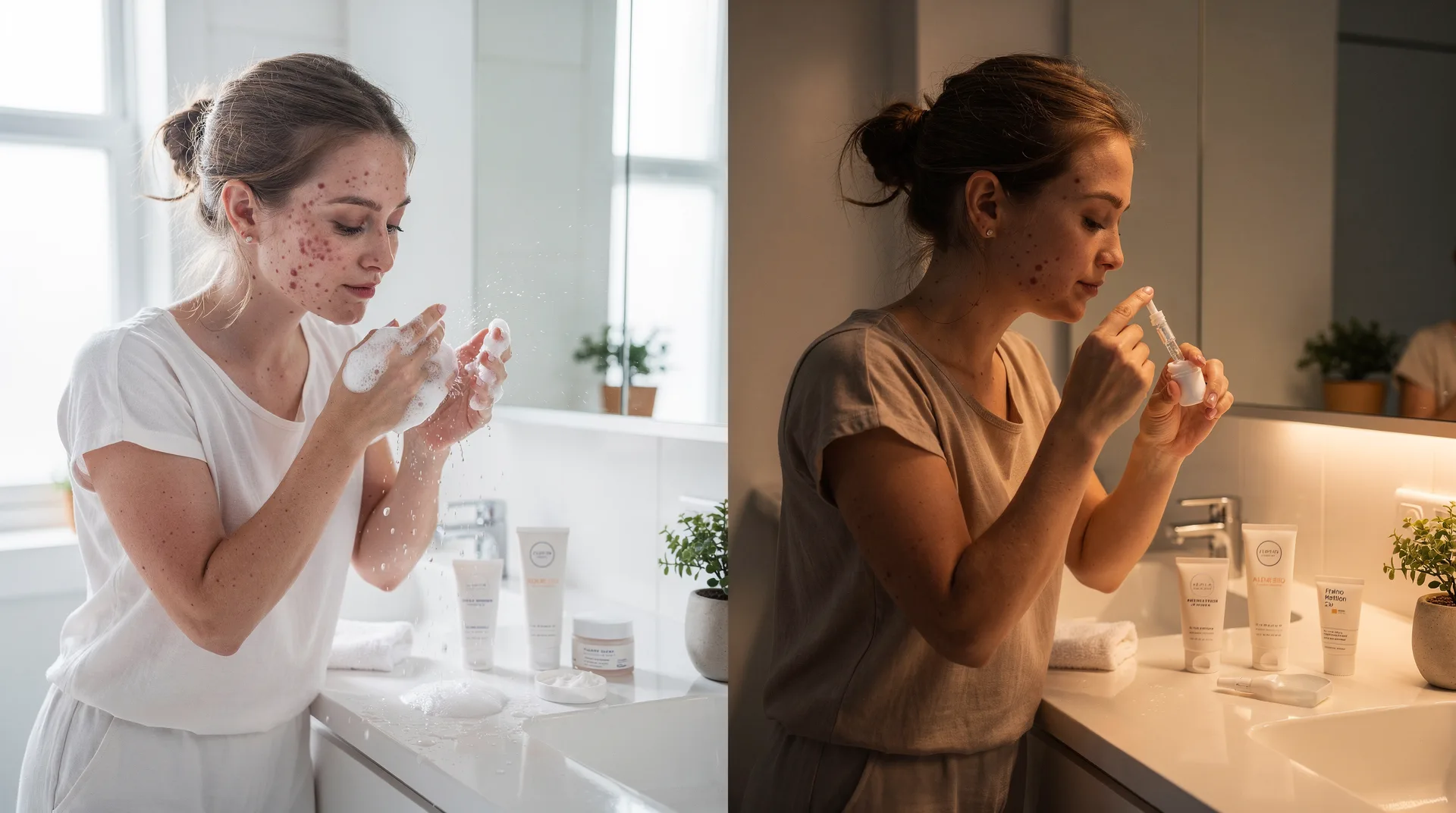
Action: Wash your face with lukewarm water (approx. 90°F – 95°F). Pump a dime-sized amount of a pH-balanced, non-foaming cleanser into your palms.
Technique: Massage the cleanser onto your skin using your fingertips in circular motions for exactly 60 seconds. Focus on the nose and chin area where oil accumulates.
Warning: Avoid “Squeaky Clean”
Result: Skin feels soft and clean, not tight or dry.
Step 2 Apply Soothing Toner (Optional but Recommended)
Action: While your skin is still slightly damp, pour a few drops of an alcohol-free toner into your hands and press (don’t rub) it into your skin.
Selection: Look for ingredients like Centella Asiatica (Cica), Allantoin, or Aloe Vera. These act as a “fire extinguisher” for redness.
Result: Skin feels hydrated and cool to the touch, ready to absorb treatment.
Step 3 Treat Breakouts Strategically
Action: Apply a thin layer of your chosen active ingredient (Azelaic Acid is the gold standard for sensitive skin; 2% BHA is an alternative) to the affected areas.
The “Sandwich Method” (Crucial for Sensitivity): To prevent irritation, choose your application method based on your skin’s current state:
| Sensitivity Level | Application Technique |
|---|---|
| High Sensitivity | Apply Moisturizer → Wait 5 mins → Apply Treatment → Apply Moisturizer (Sandwich). |
| Moderate Sensitivity | Apply Treatment → Wait 5 mins → Apply Moisturizer. |
Step 4 Moisturize to Lock in Hydration
Action: Apply a nickel-sized amount of a barrier-repair moisturizer to your face and neck.
Why: Acne treatments dry the skin. A compromised barrier leads to more acne. Hydration is key to breaking the cycle. Look for “Ceramides,” “Panthenol (Vitamin B5),” or “Niacinamide.”
Result: Your skin should look plump and dewy.
Step 5 Protect with Mineral SPF (AM Only)
Action: Apply sunscreen as the final step every morning, regardless of the weather. Use the “two-finger rule” (two strips of sunscreen on index and middle fingers) for full coverage.
Recommendation: Use Mineral Sunscreen (Zinc Oxide/Titanium Dioxide) rated SPF 30+. Chemical sunscreens convert UV rays into heat, which can trigger inflammation in sensitive acne-prone skin. Mineral options reflect the rays and are naturally soothing.
Troubleshooting Common Reactions
Even with the best routine, sensitive skin can be unpredictable. Here is how to handle issues if they arise.
- Problem: “My skin is stinging or burning.”
Fix: Stop the active treatment (Step 3) immediately. Focus only on Gentle Cleansing + Moisturizing for 3 to 5 days until the moisture barrier heals. Once the stinging stops, reintroduce the active every other day. - Problem: “My skin is peeling.”
Fix: This is common with acne treatments. Reduce treatment frequency to 3 times a week. Apply a thicker layer of moisturizer at night. - Problem: “I’m breaking out more (Purging).”
Fix: Identify the location. If breakouts are in your usual problem areas, keep going—it’s a “purge” pushing deep congestion to the surface (lasts 2-4 weeks). If you see bumps in new areas where you never break out, stop immediately; it’s a reaction to a product.
Expert Tip: The Pillowcase Factor
Expert Tips for Maximum Results
To supercharge your acne sensitive skin skincare routine, integrate these habits:
- The 24-Hour Patch Test: Always apply a new product behind your ear or on your inner arm for 24 hours before putting it on your face. Better to have a rash on your arm than an acne flare-up on your face.
- Dietary Check: If topical treatments aren’t working after 6 weeks, consider reducing high-glycemic sugar and dairy intake, as these are common internal triggers for hormonal acne.
- Double Cleanse (PM): If you wear makeup or waterproof sunscreen, use Micellar Water first to dissolve it, then follow with your gentle cleanser. This ensures no residue clogs your pores overnight.
Frequently Asked Questions about sensitive acne routines
Here are the answers to the most common questions I get from clients starting this journey.
Can I use Vitamin C with acne medication?
Yes, but be careful. Vitamin C (L-Ascorbic Acid) can be irritating at low pH levels. If you are using Azelaic Acid or BHA, use Vitamin C in the morning and your acne treatment in the evening. If your skin is extremely sensitive, skip Vitamin C until your acne is fully under control.
How long does it take to see results?
Patience is non-negotiable. While inflammation and redness can subside in a few days, clearing actual acne lesions takes about 4 to 6 weeks. This aligns with the natural skin cell turnover cycle (approx. 28 days). Do not switch products every week; consistency yields results.
Is makeup safe for acne-prone sensitive skin?
Makeup is fine, provided it is labeled “Non-comedogenic” (won’t clog pores). Mineral makeup powders are often the safest choice for sensitive skin as they allow the skin to breathe and contain fewer preservatives than liquid foundations.
Building an effective acne sensitive skin skincare routine isn’t about expensive products; it’s about consistency and respecting your skin barrier. Start with this simple 5-step protocol today, be gentle with your application, and give your skin the 4 weeks it needs to heal.