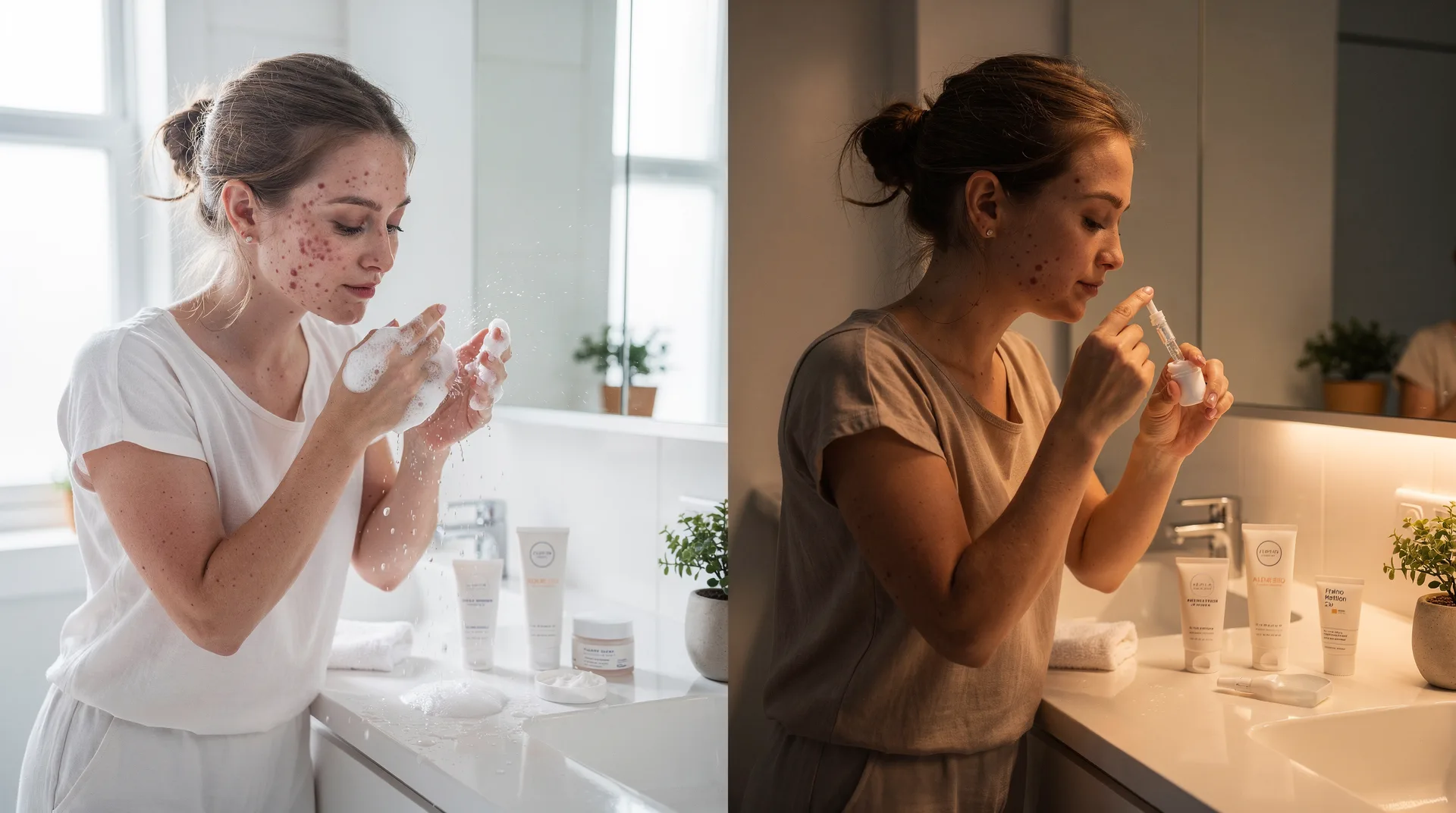
Perfect Skincare Routine For Acne Prone Skin: 4 Steps 2026
Let me tell you, back when I first started as an esthetician over 8 years ago, I struggled with painful, cystic breakouts myself. Building a highly effective skincare routine for acne prone skin doesn’t require a complicated 12-step regimen; it actually demands simplicity and consistency. Based on current dermatological consensus and clinical observations for 2026, this targeted method utilizes a minimalist approach to reduce active inflammation, clear clogged pores, and protect your skin barrier without causing extreme irritation. This protocol is highly effective for individuals dealing with hormonal, genetic, or environmental breakouts. Gather your essential products, and let’s dive into the exact morning and night sequence to get your skin back on track.
The Hook: Why This Routine Works
When your skin is breaking out, the natural instinct is to scrub it harsh and dry it out. Clinical data shows that this actually triggers an overproduction of sebum, creating a vicious cycle of more breakouts. Following this exact chronological sequence will effectively neutralize acne bacteria and fade dark spots while keeping the acid mantle intact.
This routine is completely beginner-friendly. It requires only 5 minutes in the morning and 5 minutes at night. Consistency is your biggest asset here.
Essential Preparations Before Starting
Before you wash your face, you need to ensure you have the correct toolkit. Using the wrong formulation is the number one reason acne treatments fail.
Pre-Flight Check / Core Toolkit
- Time Required: 10 minutes total daily (5 mins AM, 5 mins PM).
- Difficulty Level: Easy / Beginner.
- The Cleanser: A gentle, non-foaming gel cleanser (avoid harsh scrubs).
- The Active Treatment: Choose exactly ONE active to start (e.g., 2% Salicylic Acid serum, 2.5% Benzoyl Peroxide gel, or 0.1% Adapalene).
- The Hydration: A lightweight, oil-free, non-comedogenic moisturizer featuring Ceramides.
- The Protection: Broad-spectrum sunscreen (SPF 30 or higher, fluid/gel texture).
- Hygiene Requirement: Clean microfiber towels or disposable face cloths, and a clean bathroom sink.
4-Step Skincare Routine For Acne Prone Skin
Now that your tools are ready, it is time to execute. This is a chronological process. Steps 1 through 3 are performed both morning and night, while Step 4 is exclusively for the morning. Follow these precise instructions.
Step 1 Wash Face With A Gentle Cleanser
Action: Wet your face thoroughly with lukewarm water (ideally between 95°F – 98°F). Dispense a dime-sized amount of your gel cleanser into wet hands. Massage the product gently over your face using circular, upward motions for exactly 60 seconds. Rinse completely and pat dry with a fresh, clean towel.
Explanation: Water that is too hot will strip the skin, while cold water won’t effectively break down sebum. The 60-second rule allows the surfactants in the cleanser enough time to break down overnight sweat, residual skincare, and daytime pollution without compromising your natural lipid barrier.
Result / Checkpoint: After patting dry, your skin should feel clean, soft, and supple. If it feels tight, itchy, or “squeaky clean,” your cleanser is too harsh and you need to switch to a milder formula.
Step 2 Apply Targeted Acne Treatments
Action: Take a pea-sized amount of your chosen active treatment (like a 2% Salicylic Acid serum). Using your fingertips, press it gently into the skin. Focus primarily on acne-prone zones such as the T-zone, cheeks, or jawline. Allow the treatment to absorb fully for 1 to 2 minutes before moving on.
Explanation: Active ingredients work by penetrating deep into the pores to dissolve dead skin cells, neutralize C. acnes bacteria, and quickly reduce deep inflammation.
Expert Warning / Severe Irritation Risk
Result / Checkpoint: The skin should feel slightly tacky but not wet. The product has completely vanished into the epidermis.
Step 3 Hydrate With Non-Comedogenic Moisturizer
Action: Dispense a nickel-sized amount of your oil-free moisturizer. Smooth it evenly across your entire face and down your neck using gentle, sweeping upward motions.
Explanation: Acne treatments are inherently drying. Clinical data proves that a compromised, dehydrated skin barrier will signal the sebaceous glands to produce more oil to compensate, ultimately leading to more clogged pores. Moisturizers containing ceramides act as a seal to repair this barrier.
Result / Checkpoint: Your skin instantly looks plump, calm, and hydrated without any heavy, greasy, or suffocating residue sitting on top.
Step 4 Protect Skin With Broad-Spectrum SPF (Morning Only)
Action: Squeeze exactly two finger-lengths (index and middle finger) of an oil-free, SPF 30+ sunscreen. Spread it generously over your face, neck, and ears. Let it set untouched for 10 to 15 minutes before applying any makeup.
Explanation: Acne actives make the newly exfoliated skin highly photosensitive. UV exposure triggers melanin production, which turns healing pimples into stubborn, dark post-inflammatory hyperpigmentation (acne scars). Sunscreen is your ultimate scar-prevention tool.
Result / Checkpoint: The skin has a natural, protected finish. The sunscreen is fully absorbed without leaving a chalky white cast or pilling when touched.
Troubleshooting Common Skincare Mistakes
Even with a flawless routine, your skin might react as it adjusts. If you encounter these specific issues, here is exactly how to fix them on the spot.
- Problem: Extreme Peeling or Redness.
The Fix: You are pushing your skin too hard with actives. Immediately cut back your Step 2 (Acne Treatment) to every other night. Focus heavily on Step 3 (Hydration). Apply moisturizer to damp skin to lock in extra water. - Problem: “Skin Purging” vs. Real Breakouts.
The Fix: It takes a professional eye to know the difference. If you get tiny whiteheads in areas where you normally break out within the first 2 weeks of using an active, it is purging. This typically resolves within 4 to 6 weeks. However, if you develop deep, painful cysts in new areas where your skin is usually clear, a product ingredient is clogging your pores. Stop using it immediately.
Expert Tips For Maximum Results
To elevate your results, you must look beyond the bottles. Skincare hygiene is just as crucial as the topical ingredients.
Pro Tips from the Clinic
Change Pillowcases Frequently: Swap your pillowcase every 2 to 3 days. Sleeping on a dirty pillowcase presses your clean face directly into eight hours of accumulated dead skin cells, drool, and bacteria.
Do Not Pop Pimples: I know it is tempting, but squeezing forces bacteria deeper into the follicle, causing a massive inflammatory response. Instead, apply a hydrocolloid pimple patch over active whiteheads before bed. It safely extracts the pus overnight while protecting the area from your fingers.
| Routine Phase | Morning (AM) Protocol | Night (PM) Protocol |
|---|---|---|
| Cleansing | Gentle wash (60 seconds) | Double cleanse (if wearing makeup/SPF) |
| Treatment | Vitamin C or light BHA | Retinoid or Benzoyl Peroxide |
| Hydration & Protection | Light moisturizer + SPF 30+ | Barrier-repair moisturizer only |
Frequently asked questions about a skincare routine for acne prone skin
During my years of consulting, I continually hear the same doubts from clients transitioning to a new protocol. Here are the clear, science-backed answers to keep you on the right path.
How long does it take to see real results from an acne routine?
Patience is key. The human skin cell turnover cycle naturally takes between 28 to 30 days. You cannot force this biological limit. You should expect to see a visible reduction in inflammation and new breakouts after 4 to 6 weeks of consistent daily use.
Should I skip moisturizer if my skin feels extremely oily?
Absolutely never. This is the biggest pitfall. Skipping your moisturizer triggers the skin to believe it is under attack from dehydration. The glands will instantly produce excess sebum to overcompensate, significantly worsening your acne. Always use a lightweight, gel-based moisturizer.
Can I still wear makeup over this routine?
Yes, you certainly can. However, you must ensure that your foundation and concealers are strictly labeled as “non-comedogenic” (meaning they will not clog pores). Furthermore, if you wear makeup, you must double-cleanse at night (using a micellar water before your gel cleanser) to remove the silicone and pigment completely.
In conclusion, beating acne isn’t about attacking your skin; it is about supporting it. By strictly following this 4-step skincare routine for acne prone skin, you are creating an environment where bacteria cannot thrive, and healthy cells can regenerate. Stick to the routine for at least 30 days, protect your barrier, and watch your complexion transform.