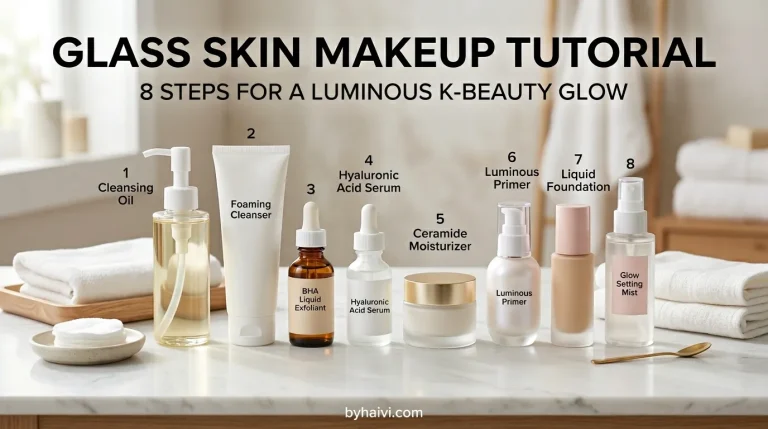
Guide to Skincare Routine Order: 7 Steps for Glowing Skin 2026
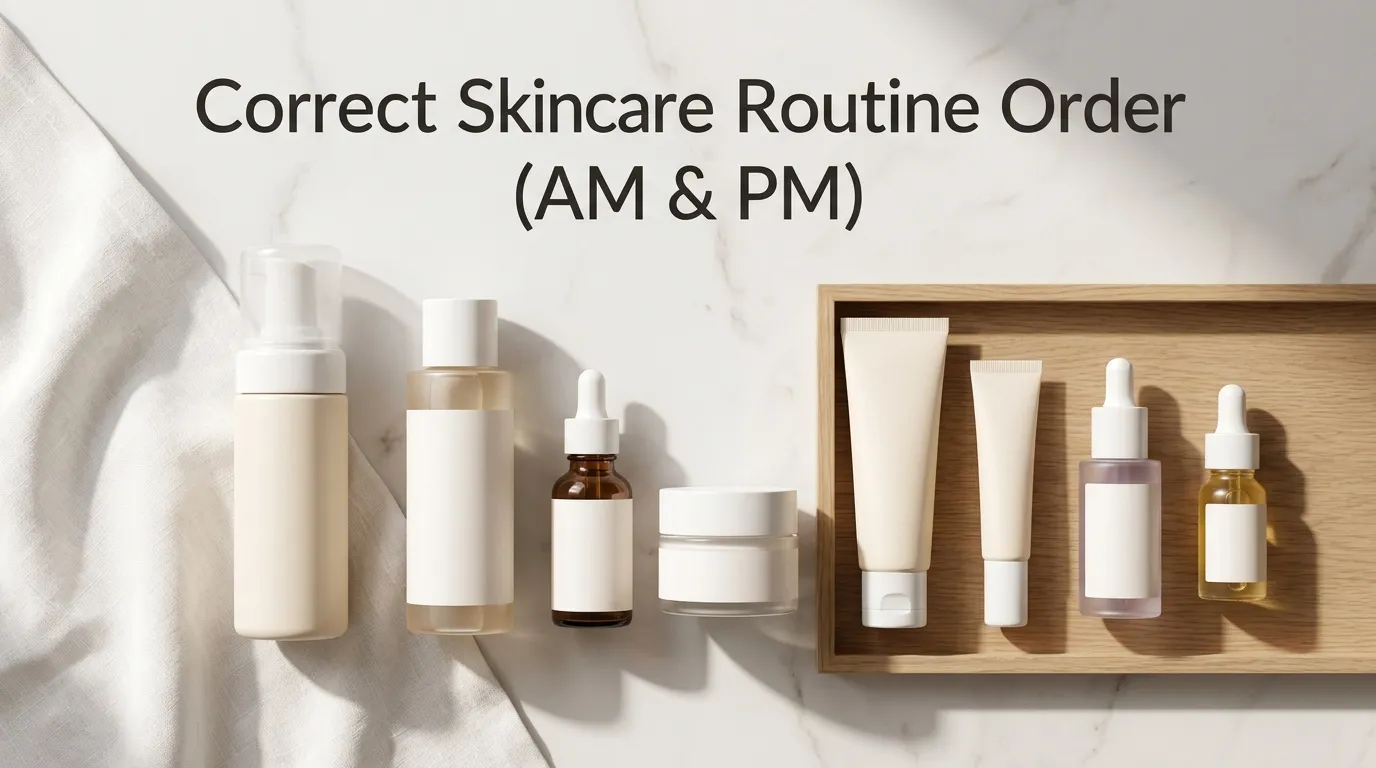
To truly master the skincare routine order, you need to follow a dermatologist-approved method based on product consistency and function, moving from the thinnest texture to the thickest. This guide provides the definitive, step-by-step process that ensures each product—from your Vitamin C serum to your Retinol—penetrates effectively instead of being blocked. This method is suitable for all skin types and is designed to deliver maximum results for glowing, healthy skin in under 15 minutes a day. Let’s gather your products and get started on building the perfect routine right now.
Preparing Your Skincare Toolkit: The Essentials
To ensure your skincare layering process is seamless and effective, you need to have the right products ready. Here’s everything you need before we begin.
- Total Time: 5-10 minutes (Morning) / 10-15 minutes (Evening).
- Difficulty: Beginner.
- Core Products (Non-Negotiable): A gentle cleanser, a moisturizer suited to your skin type, and a broad-spectrum sunscreen (SPF 30 or higher).
- Treatment Products (Optional, add as needed): Toner or Essence, Serums (e.g., Vitamin C, Hyaluronic Acid, Niacinamide), Eye Cream, Exfoliants (AHA, BHA), Retinoids (Retinol), and Face Oil.
- Prerequisite: You must have a basic understanding of your personal skin type (e.g., oily, dry, combination, sensitive) to choose the right products.
The 5-Step Morning (AM) Skincare Routine Order: Protect & Preserve
The goal of your morning routine is simple: protect your skin from the sun, pollution, and other environmental stressors you’ll face throughout the day. Follow these 5 steps precisely to create a protective shield for your skin.
Step 1 Cleanse to Start Fresh
Action: Wet your face with lukewarm water, apply a coin-sized amount of a gentle cleanser, and massage it into your skin in circular motions for a full 60 seconds before rinsing thoroughly.
Explanation: This action removes any sweat, excess oil, and bacteria that have accumulated overnight. It creates a clean canvas, ensuring the products you apply next can penetrate properly.
Result: Your skin should feel clean and refreshed, but not tight or stripped. If it feels dry, your cleanser may be too harsh.
Step 2 Apply Toner or Essence (Optional)
Action: Pour a few drops of toner or essence into your palms or onto a cotton pad. Gently press or swipe it over your face and neck.
Explanation: Toners help to balance your skin’s pH level and remove any final traces of impurities. Essences provide an initial, lightweight layer of hydration to prep the skin for serums.
Result: Your skin will feel damp and plump, ready to absorb the next treatment step more effectively.

Step 3 Treat with an Antioxidant Serum
Action: Dispense 2-3 drops of an antioxidant serum, like Vitamin C, onto your fingertips. Gently pat and press the serum into your entire face and neck, avoiding the immediate eye area.
Explanation: Antioxidants are your skin’s daytime defense. They neutralize free radicals from UV rays and pollution, which are responsible for premature aging and cellular damage.
Result: The serum should absorb quickly without leaving a sticky residue. Your skin is now armed with a layer of environmental protection.
Pro Tip for Maximum Absorption
Step 4 Moisturize to Hydrate
Action: Scoop a pea-sized amount of moisturizer. Warm it between your fingers for a few seconds, then gently press it into your skin to lock in hydration.
Explanation: Your moisturizer seals in the serum you just applied and forms a protective barrier on your skin’s surface to prevent water loss throughout the day.
Result: Your skin should feel soft, hydrated, and smooth. Even oily skin needs this step; opt for a lightweight gel formula if you’re prone to shine.
Step 5 Protect with Sunscreen
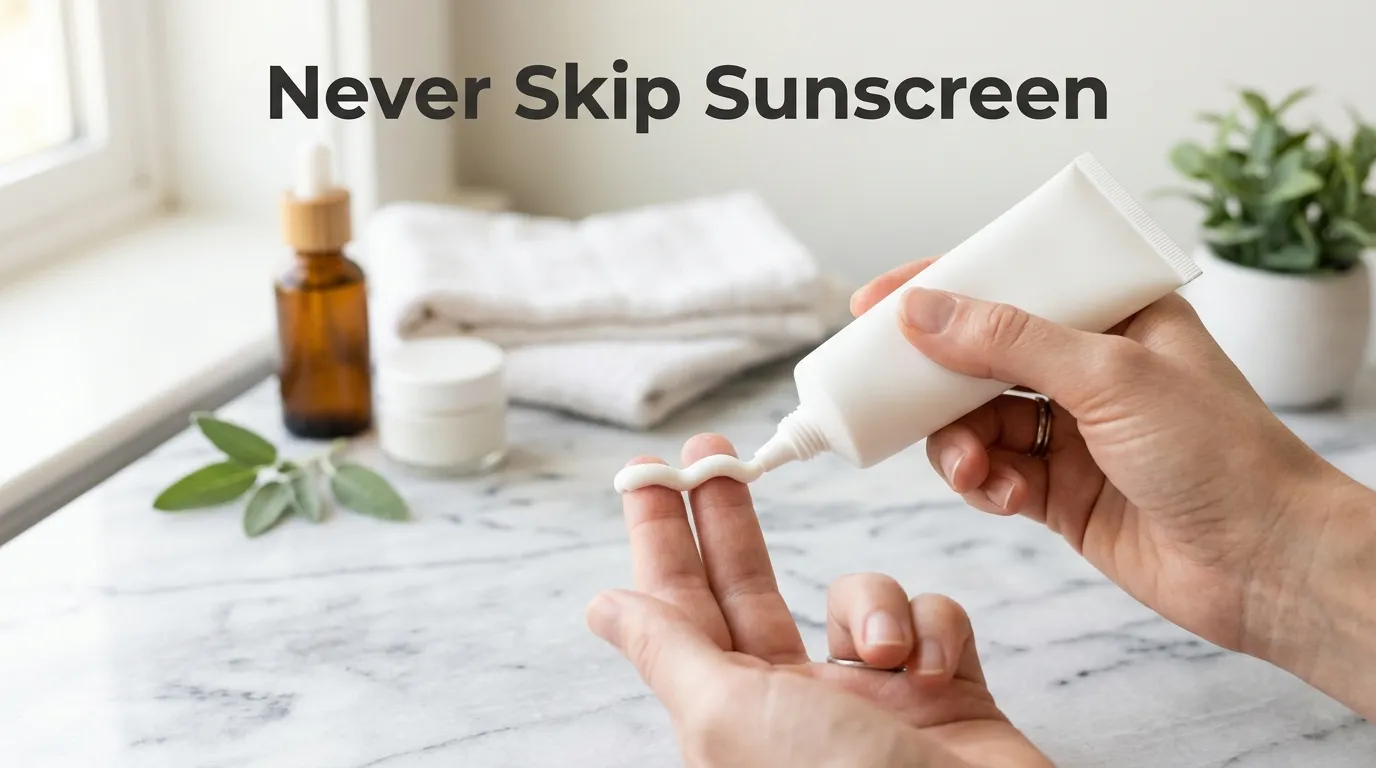
Action: Squeeze a generous amount of broad-spectrum sunscreen—about two fingers’ length for your face and neck—and apply it evenly as the final step in your routine.
Explanation: This is the single most important anti-aging step. Sunscreen protects your skin from UVA (aging) and UVB (burning) rays, preventing wrinkles, hyperpigmentation, and skin cancer.
Result: After application, your skin is fully protected. Modern formulas should not leave a heavy white cast or feel overly greasy.
Critical Warning: Avoid Product Pilling
The 7-Step Evening (PM) Skincare Routine Order: Repair & Rejuvenate
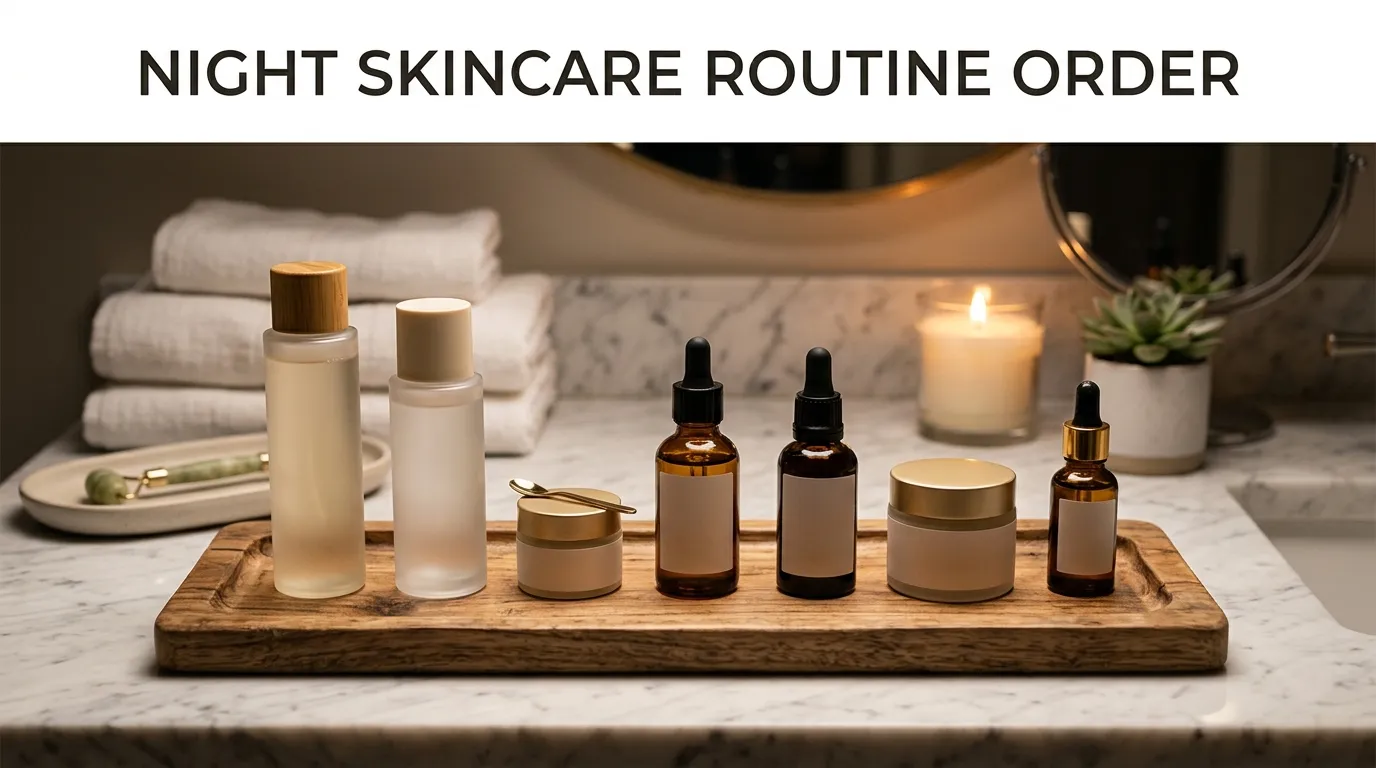
Your nighttime routine is focused on cleansing the day away and delivering potent, targeted treatments. This is when your skin’s natural repair cycle is most active, so we will use this time to treat concerns and deeply nourish the skin.
| The Golden Rule of Layering | Application Order Example |
|---|---|
| Thinnest to Thickest | Always apply your products starting with the most watery consistency (like a toner or essence) and finishing with the thickest or most occlusive (like a moisturizer or face oil). |
| Water-based before Oil-based | Water-based products cannot penetrate through oil-based products. Apply your hydrating serums (like Hyaluronic Acid) before any face oils. |
Step 1 Double Cleanse to Remove Buildup
Action: First, massage an oil-based cleanser or cleansing balm onto your dry face for 60 seconds to break down makeup, SPF, and sebum. Rinse with water. Second, follow up with your regular water-based cleanser.
Explanation: A single cleanse is often insufficient to remove stubborn, oil-based impurities. The first cleanse dissolves them, and the second cleanse washes everything away, leaving your skin perfectly clean.
Result: Your skin is completely free of all makeup and sunscreen, which prevents clogged pores and breakouts.
Step 2 Exfoliate or Apply a Mask (2-3 Times a Week)
Action: On your designated nights, after cleansing, apply a chemical exfoliant (like an AHA/BHA toner) or a treatment mask (clay for deep cleaning, hydrating for moisture) as directed by the product instructions.
Explanation: Exfoliation removes the top layer of dead skin cells, leading to a brighter complexion and better product absorption. Masks provide a concentrated dose of active ingredients.
Result: Post-exfoliation, skin will look brighter and feel smoother. Post-masking, skin will feel purified or deeply hydrated, depending on the mask type.
Step 3 Apply Toner or Essence
Action: Gently pat your toner or essence onto your face and neck.
Explanation: This step rehydrates and preps the skin after the deep-cleaning steps, ensuring your treatment serums will work at peak efficiency.
Result: Your skin feels balanced and damp, creating the perfect environment for the next steps.
Step 4 Apply Eye Cream
Action: Take a rice-grain-sized amount of eye cream on your ring finger. Gently tap it around the orbital bone, from the inner to the outer corner.
Explanation: The skin around your eyes is the thinnest on your body and needs specialized care. Applying it before other treatments prevents potent actives (like retinoids) from migrating to this delicate area and causing irritation.
Result: The eye area is hydrated and protected.
Step 5 Treat with Serums and Retinoids
Action: Apply your targeted treatment serums or retinoids. If using a retinoid, ensure your face is completely dry to minimize potential irritation. Pat the product in, don’t rub.
Explanation: This is the “workhorse” step where you address your primary skin concerns—wrinkles (Retinol), dark spots (Niacinamide), or dehydration (Hyaluronic Acid).
Result: The active ingredients are delivered directly to your skin to begin their repair work overnight.
Step 6 Moisturize to Seal Everything In
Action: Apply a generous layer of your nighttime moisturizer over your face, neck, and décolletage.
Explanation: Your night cream locks in the active ingredients from your treatment step, preventing them from evaporating. It also provides essential lipids and moisture to support your skin’s overnight repair process.
Result: Your skin feels nourished, and a protective barrier is formed to prevent moisture loss while you sleep.
Step 7 Add a Face Oil (Optional)
Action: If you have dry or mature skin, press 2-3 drops of face oil over your moisturizer as the very final step.
Explanation: Oils are occlusive, meaning they create a final seal over everything you’ve applied. This is particularly beneficial for dry skin types to lock in maximum moisture.
Result: Your skin has a healthy, dewy glow and is sealed for the night.
Common Mistakes in Skincare Layering & How to Fix Them
Even with the right steps, you can run into issues. Based on clinical observation, here are the most common problems I see and exactly how to correct them.
- Problem: My products are “pilling” (rolling up into little balls).
Fix: This is almost always caused by two things: using too much product or not waiting long enough between layers. Reduce the amount you’re using (a pea-size for creams, 2-3 drops for serums) and wait 30-60 seconds for each layer to absorb before applying the next. - Problem: My skin is red and irritated.
Fix: You are likely over-using active ingredients. Never use a strong chemical exfoliant (AHA/BHA) on the same night as a retinoid. If irritation occurs, strip your routine back to the basics (cleanse, moisturize, SPF) for a few days, then slowly reintroduce one active ingredient at a time. - Problem: My skin feels sticky or greasy after my routine.
Fix: This indicates you’re either using too much product or the products are too heavy for your skin type. Use smaller amounts, and if the issue persists, switch to more lightweight, “oil-free” or “non-comedogenic” formulas.
Expert Tips for Maximum Effectiveness
- Listen To Your Skin: You do not need to perform every single step every single day. If your skin feels sensitive, skip the exfoliants and retinoids. If it feels extra dry, add a hydrating mask or a face oil. A successful skincare routine is intuitive, not rigid.
- The “Wait Time” Rule: While 30-60 seconds between layers is ideal, the only mandatory wait time is for retinoids (apply to fully dry skin) and sunscreen (apply after moisturizer has set).
- Patch Test First: Before incorporating a new active product, always apply a small amount to a discrete area (like behind your ear or on your inner arm) for 2-3 consecutive days to check for any signs of an adverse reaction.
Frequently Asked Questions about Skincare Routine Order
I get these questions all the time. Here are the quick, direct answers to help you perfect your routine.
How long should I really wait between skincare steps?
For most products, 30-60 seconds is more than enough time for absorption. The key exceptions are potent actives like retinoids, which should be applied to completely dry skin to minimize irritation, and sunscreen, which should be applied after your moisturizer has had about a minute to set.
Do I really need a separate AM and PM routine?
Yes, absolutely. Their functions are entirely different. Your AM routine is for protection (using antioxidants like Vitamin C and sunscreen). Your PM routine is for correction (using cleansers to remove buildup and actives like retinoids or exfoliants to repair and treat).
Where does spot treatment go in the routine?
Apply acne spot treatments at night, after cleansing and toning but before your moisturizer. If you have a very potent, drying spot treatment, you can apply it after your moisturizer to create a small buffer and reduce potential irritation to the surrounding skin.
Can I mix Vitamin C and Retinol?
It is strongly advised not to use them in the same routine. They operate at different pH levels and using them together increases the likelihood of significant skin irritation while potentially destabilizing the formulas. The professional consensus is clear: use Vitamin C in the morning (AM) to protect, and Retinol at night (PM) to repair.